


Focusrite Scarlett Solo (3rd Gen) USB Audio Interface with Pro Tools | First
**Focusrite Scarlett Solo 3rd Gen Review: The Gateway Drug to Professional Home Recording**
Step into any professional recording studio and you'll likely spot Focusrite gear in the rack. Now, the company brings that same DNA to bedroom producers and podcasters with the Scarlett Solo, an audio interface that promises to bridge the gap between amateur recordings and professional productions. This little red box has become almost synonymous with home recording, but does it live up to its reputation as the go-to interface for beginners and budget-conscious creators?
**Product Features and Specifications**
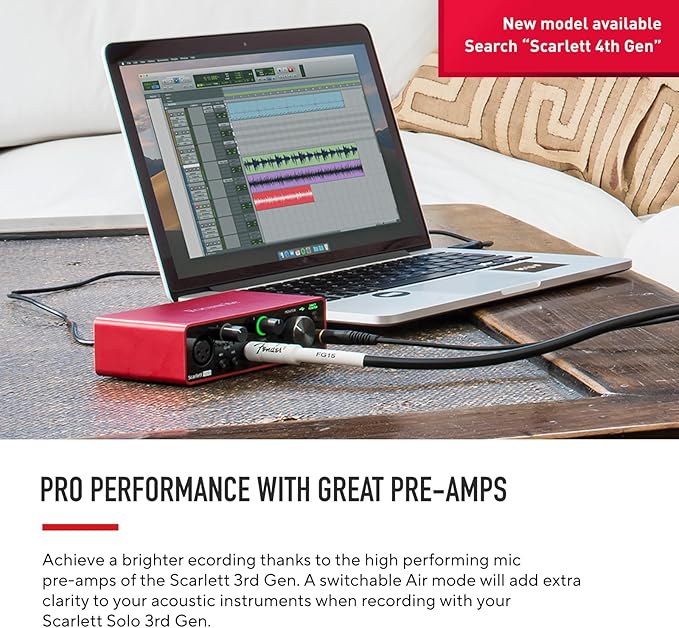
The Scarlett Solo 3rd Generation packs impressive technology into its compact, desktop-friendly chassis. At its core are Focusrite's best-performing preamps in the Scarlett range, featuring a switchable Air mode that adds brightness and presence to vocal recordings by emulating the company's legendary ISA preamp. This subtle enhancement can make the difference between muddy home recordings and that professional sparkle you hear on commercial releases.
The interface offers one XLR microphone input with phantom power for condenser mics and one high-headroom instrument input perfect for direct guitar and bass recording. Both inputs feature Gain Halos, LED rings around the gain knobs that show green for optimal signal, amber for approaching peak levels, and red for clipping. This visual feedback eliminates guesswork and helps prevent distorted recordings that plague many home studios.
Recording quality reaches professional standards with 24-bit/192kHz conversion, ensuring your recordings capture every nuance of your performance. The 56dB gain range provides plenty of clean amplification for even the most gain-hungry dynamic microphones. On the output side, dual balanced outputs deliver crystal-clear monitoring, while the dedicated headphone output with independent volume control allows for private listening sessions.
The bundled software sweetens the deal considerably. Pro Tools First provides a legitimate introduction to industry-standard recording software, while additional plugins and virtual instruments from Ableton, Softube, and others expand creative possibilities. The Easy Start online tool simplifies initial setup, walking users through driver installation and basic configuration without requiring an engineering degree.
**What Customers Are Saying**
Users consistently praise the Scarlett Solo's build quality and sound performance. The preamps deliver notably clean recordings with minimal noise floor, a significant upgrade from cheaper interfaces or direct computer recording. Many report their dynamic microphones suddenly coming to life with proper gain staging, while condenser mics benefit from the transparent, uncolored amplification.
The Air mode receives particular acclaim from vocalists who appreciate the subtle enhancement it provides. Rather than heavy-handed processing, it adds just enough presence to help vocals sit properly in a mix without sounding artificial. Guitarists love the high-headroom instrument input that captures their tone without unwanted compression or distortion, preserving the dynamics of their playing.
Setup experiences vary considerably. While many find the process straightforward, others report the web-based Easy Start tool feels dated and occasionally awkward. Once configured, however, the interface works reliably across different recording software, though some users needed to experiment with buffer settings to minimize latency during real-time monitoring.
Several frustrations emerge in customer feedback. The advertised free software often turns out to be time-limited trials rather than full versions, requiring multiple account creations across different platforms. Some users find this misleading and annoying when they just want to start recording. Headphone output volume disappoints some users who need to crank the knob for adequate monitoring levels, particularly with high-impedance headphones.
Latency remains an issue for certain users, especially those hoping to monitor their playing through software effects in real-time. While the interface supports direct monitoring with zero latency, hearing processed signals requires careful buffer adjustment and still introduces slight delays that can be distracting during performance.
**Who Should Buy This**
The Scarlett Solo suits solo musicians, podcasters, and content creators who typically record one source at a time. Singer-songwriters will appreciate the ability to record professional-quality vocals and instruments without breaking the bank. Podcasters benefit from the clean preamps and simple operation that delivers broadcast-quality voice recordings.
Canadian home studio enthusiasts facing space constraints will value its compact footprint that fits comfortably on any desk. Students in music production programs get an affordable introduction to professional recording standards without student loan-inducing prices.
However, those needing simultaneous multi-track recording should consider the Scarlett 2i2 or larger interfaces. Electronic musicians working entirely in-the-box might find a simpler, bus-powered interface more suitable.
**Final Verdict**
The Focusrite Scarlett Solo 3rd Generation earns its reputation as the default choice for entry-level home recording. While not perfect, it delivers where it counts most: clean, professional-sounding recordings at an accessible price point. The combination of quality preamps, reliable drivers, and useful bundled software creates a complete recording solution that grows with developing skills.
Minor annoyances like trial software and modest headphone output pale against the core achievement of democratizing professional recording quality. For Canadian creators taking their first serious steps into home recording, the Scarlett Solo provides a solid foundation that won't need replacing until your needs significantly expand. It's the interface you'll either use for years or fondly remember as the tool that launched your recording journey.
As an Amazon Associate, we earn from qualifying purchases.